
Next update notification will go out TBD.
Mark your calendar and come see us Saturday, Oct. 17th: Daguerreian Society Photo Fair
Location:
Hyatt Regency Washington on Capitol Hill
400 New Jersey Avenue, NW
Washington, DC 20001
Congressional A Ballroom, lobby level
Admission:
Symposium attendees: 9am, free
General public: 10am–4pm, $10
Our New Address:
Medhurst & Co
681 San Joaquin Rd.
Poinciana, FL 34759
You will notice some changes to the website. We are in the process of rebuilding and recovering from a malicious attack on the servers of our web host. The result was that the attackers were able to delete many websites including mine. We were able to recover a 2024 copy and I am rebuilding from that point. Everything is functional, but we lost listings that we are relisting. Check the new arrivals page regularly as it will be growing more or less daily.
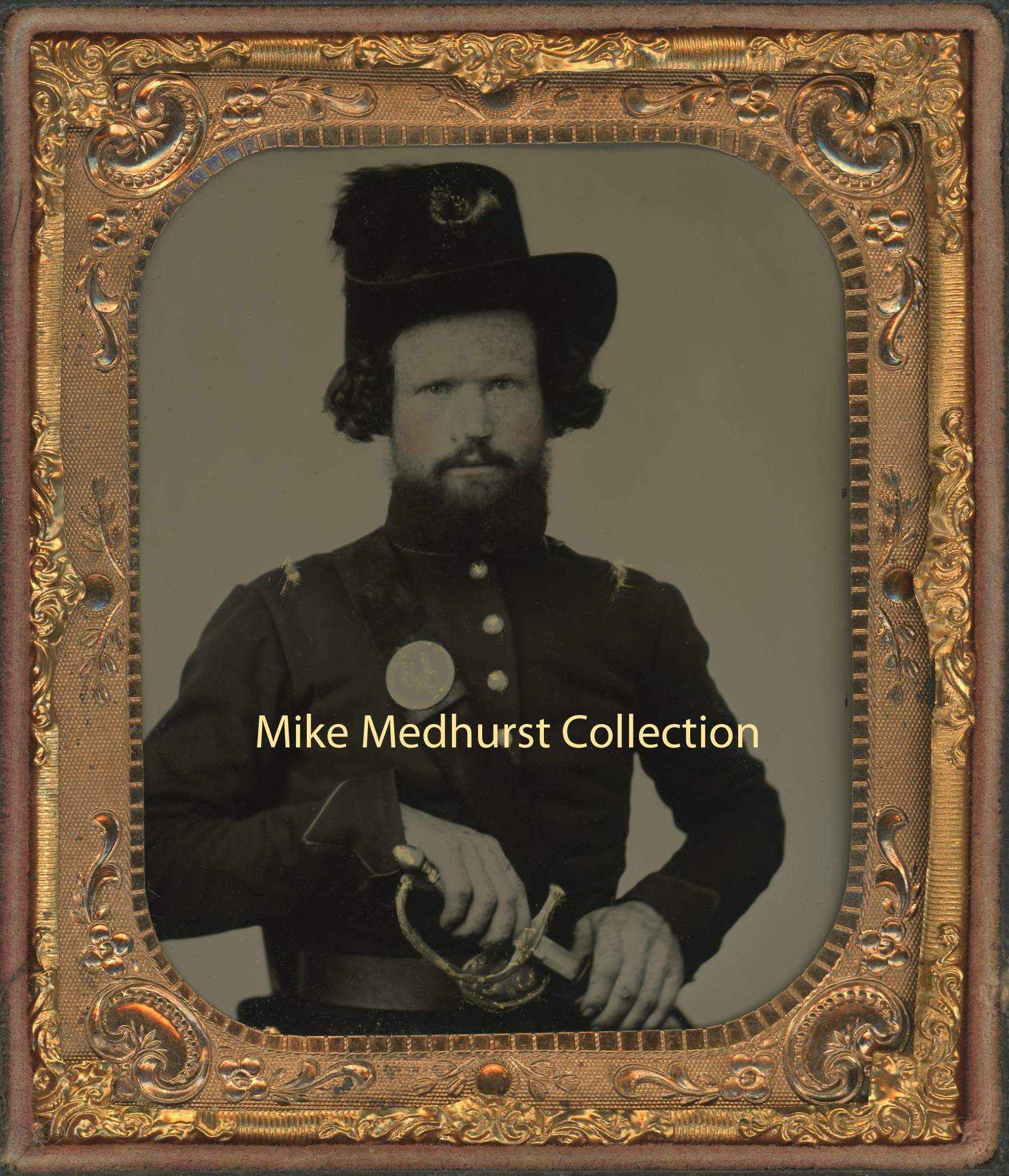
Below is a Tintype from my collection for your enjoyment.
Marion L. Wilmot 1/6 plate ruby
ambrotype
Marion Lafayette Wilmot Left
Illinois In 1852 joining a party of 40 and crossed the plains to California. He
mined in Placer County until the fall of 1854 when he decided to return East.
He went to San Francisco, and taking passage on the Yankee Blade, was in the
disaster off Point Conception in which 300 of the 1300 passengers were lost. He
was rescued, but $5000 in gold and all his personal belongings went to the
bottom of the sea. He was taken to San Francisco by the steamer Goliath, and
again engaged in mining. This did not prove a success, so he returned to San
Francisco. There he took passage on the Clipper Westward Ho bound for China. He
returned to California. He then shipped on a Peruvian bark for a year and at
Valparaiso on the The Flying Dutchman for Baltimore; from this city he returned
to Kentucky and then to Illinois.
He was married in the Spring of 1859 they settled in Bourbon Co., Kansas. There
he followed farming until 1861, when he enlisted in the sixth Kansas Voluntary
Infantry. He participated in the Battle of Osage, Dry Woods and many
skirmishes. He was mustered out at Wyandotte, Kansas and returned to his home
resuming his farming operations which he continued until 1864 when he once
again crossed the plains ... his objective point being to settle in Oregon.
Forty miles west of Fort Laramie, they had 21 horses stolen by the Indians and
a spirited engagement followed in which 3 of the little band were killed and
many others wounded. Mr. Wilmot received 10 arrows in his body and became separated
from his companions. He was taken up by another train and kindly cared for
until restored to his family and friends. In the summer of 1865, he bought 520
acres of land on Fall Creek {Lane County, Oregon}, where he farmed until 1871.
He later was appointed Postmaster of Springfield. Mr Wilmot died in 1909,
leaving no children
Email: medhurstmd@aol.com
Phone: 913-851-8462